
2 min read

DFE: Testing Filters Under Real-Life Conditions (Part 2 of 4)

By Hy-Pro Marketing on Tue, Jun. 27, 2017

Last week, in part one, we briefly discussed how filter elements are rated by manufacturers. This week we're discussing the industry standard ISO16889 multi-pass test and Hy-Pro's standard, the DFE test. (Already read part two? Read parts three and four.)

Current Filter Performance Testing Methods

To understand the need for DFE, it is important to understand how filters are currently tested and validated. Manufacturers use the industry standard ISO16889 multi-pass test to rate filter efficiency and dirt-holding capacity of filter elements under ideal lab conditions.

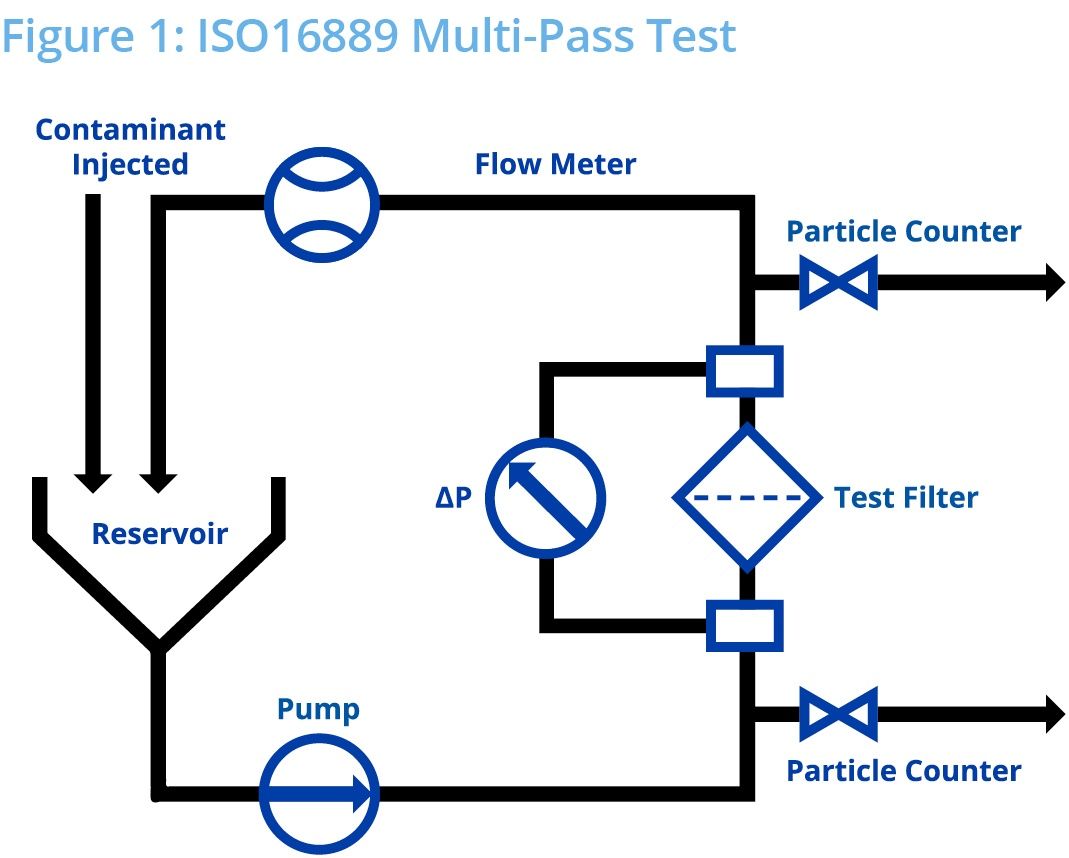
Figure 1 depicts the test circuit where hydraulic fluid is circulated at a constant flow rate in a closed-loop system with on-line particle counters before and after the test filter. Contaminated fluid is added to the system at a constant rate. Small amounts of fluid are removed before and after the filter for particle counting to calculate the filter efficiency (capture). The capture efficiency is expressed as the Filtration Ratio (Beta) which is the relationship between the number of particles greater than and equal to a specified size (Xμ[c]) counted before and after the filter. In real-world terms, this test is the equivalent of testing a filter in an off-line kidney loop rather than replicating an actual hydraulic or lube system. It’s basically a filter cart test.
Topics: ISO 16889 case study filter performance filter elements
3 min read

DFE: Testing Filters Under Real-Life Conditions (Part 1 of 4)

By Hy-Pro Marketing on Tue, Jun. 20, 2017

The Dynamic Filtration Efficiency (DFE) Test is Hy-Pro's standard for testing filter elements. Throughout this four-part series  (find parts two, three and four) we'll discuss what it is, why it matters and why elements engineered with this test in mind outperform others in real-life applications.

First, let's start with the basics.

Why are filters used? How are they rated?

All hydraulic and lube systems have a critical contamination tolerance level that is often defined by -- but not limited to -- the most sensitive system component such as servo valves or high-speed journal bearings. Defining the ISO fluid cleanliness code upper limit is a function of component sensitivity, safety, system criticality and ultimately getting the most out of hydraulic and lube assets.

Topics: ISO 16889 case study filter performance filter elements
1 min read

Filter Sizing: Calculating Clean Element Delta P

By Hy-Pro Marketing on Wed, Nov. 19, 2014

Choosing the best filter element size and media for a specific application can be tricky. You want media that is tight enough to help you reach your target ISO code. However, if you choose a media that is too tight for your application, the element differential pressure (Delta P or ΔP) will rise too quickly and you will be replacing elements far too frequently.

To prevent these situations you should always calculate clean element Delta P whenever changing the filter media or manufacturer.

Topics: hydraulic fluid filter sizing filter elements
3 min read

How to Change Out a Filter Element

By Hy-Pro Marketing on Wed, Jun. 11, 2014

Changing a filter element can cause massive contamination ingression if the proper precautions are not taken and the proper procedures followed. We have compiled a step-by-step guide to minimize contamination ingression while changing out elements. Check out how to change out a filter element below 

Topics: contaminination filter elements
3 min read

[Video] Water Contamination and Removal Methods

By Scott Howard on Mon, Jun. 02, 2014


Do you know what the 3 different types of water contamination are? What about the 4 methods to remove water from your fluid? Watch our short video for a thorough explanation of each.
Topics: hydraulic fluid water vacuum dehydrator coalesce technology headspace dryer video contaminination filter elements
2 min read

Why You Need Proper Filtration in Front of Your Control Valves

By Scott Howard on Mon, Sep. 23, 2013

Proper filtration keeps control valves from becoming faulty and failing.

Most people have at least heard the term control valve, even if they don't know exactly what it does. For those of you caring for hydraulic systems, you likely work intimately with these parts. Did you know that if you're not using proper filtration in front of said control valves that you're likely doing your operation a disservice? (It's true.)

Topics: contaminination filter elements
1 min read

Eliminating Filter Element Sparking

By Hy-Pro Marketing on Mon, Aug. 12, 2013

Static electricity is an amazing thing. It can cause hairs to stand on end when rubbed with a balloon, which can cause it to then stick to a wall. (It’s a fun trick, especially for kids). Unfortunately, when it comes to interaction with filters, static can have devastating results.

Topics: thermal event varnish SVR NSD filter elements
5 min read

Hydraulic and Lubrication Filter Types and Locations

By Hy-Pro Marketing on Thu, Jan. 31, 2013

water

Selecting the right filter can improve the reliability of a system and eliminate failure. With so many options available, we understand how difficult it can be to choose just the right one. Let’s take a look at some of the hydraulic and lubrication filter types and where/how they are predominantly used to help you make the best choice for your filtration needs.

Topics: offline filtration duplex low-pressure hydraulic duplex high-pressure filter elements lube oil
4 min read

Glass or Cellulose Filter Media?

By Hy-Pro Marketing on Mon, Sep. 17, 2012

Glass or Cellulose: Which Hydraulic Filter Media is Best?

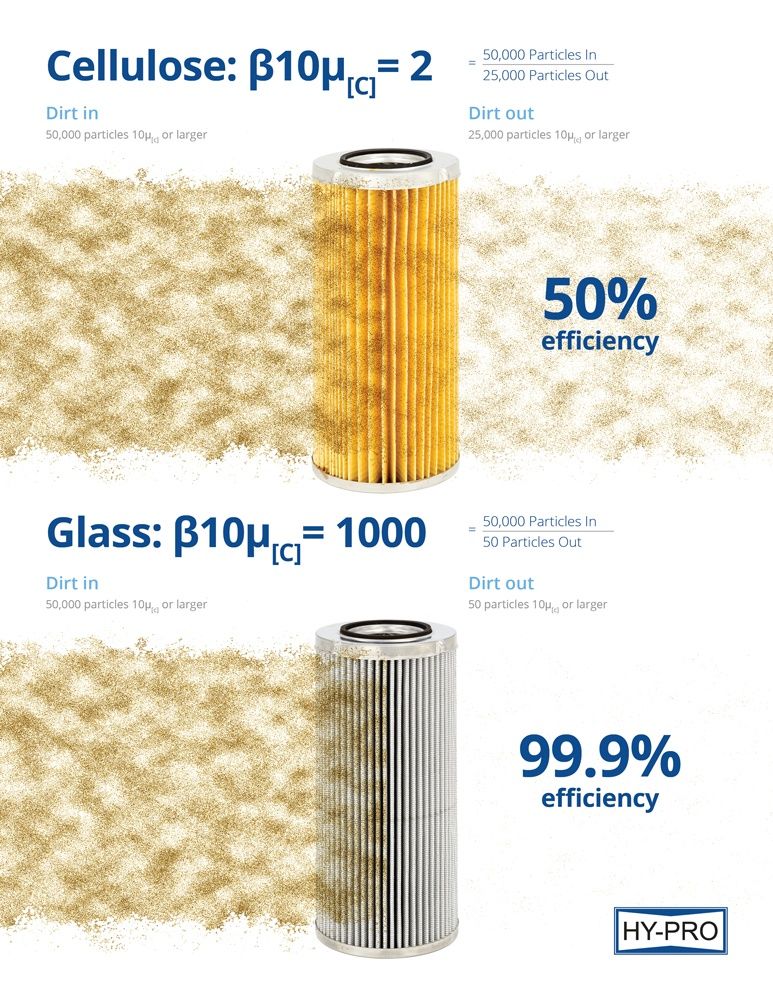
There are several distinct differences between glass and cellulose media. Media selection should be based on the required cleanliness and other unique needs of the system. Evaluate the Beta ratio (efficiency), dirt holding capacity, flow versus pressure drop characteristics, etc. A hydraulic filter supplier should be able to supply more detailed test information in addition to what is supplied in the literature.

Topics: hydraulic fluid ISO 16889 cellulose media filter elements filter comparison glass media

Featured

Sign up for updates