

1 min read

Hy-Pro's Product Spotlight: Compact Offline Filter (COF)

By Hy-Pro Marketing on Thu, Apr. 01, 2021

Hy-Pro's Compact Offline Filter

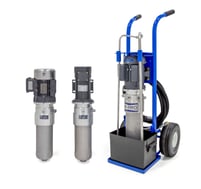
Our newest and smallest unit yet, the Compact Offline Filter is ableCOF_Group-2 to fit where no other filtration equipment can. Ideal for smaller systems or where a larger offline system wouldn't fit, this solution can be permanently installed or made portable for ease of use. 
Topics: hydraulic fluid contamination dirt Water Contamination hydraulic filters hydraulic and lubrication filter types Gearbox filtration new oil micro-dieseling fluid samples filtration oil analysis hydraulic pump filters hydraulic valve FSL liquid conditioning station duplex low-pressure oxidation Noria NSD hydraulic cellulose media compressor Reliable Plant filter comparison lube oil aluminum refinery conditioning turbine oil glass media
3 min read

Getting to Know Demulsibility

By Hy-Pro Marketing on Thu, Mar. 25, 2021

Demulsibility

What is Demulsibility?

Demulsibility is the ability of oil to separate from water. Oil and water naturally separate because like molecules attract each other. Oil sticks with oil, water sticks with water. Oil is "hydrophobic", or "afraid of water," which is a benefit when it comes to fluids like turbine oil. 

Topics: varnish in hydraulic oil varnish in turbine oil contamination water in oil dirt Phosphate Ester diesel engine maintenance steel mills vacuum dehydration rolling mill lubricating oil filter housing sizing micro-dieseling thermal event ISO 4406 vacuum dehydrator fluid samples oil analysis metal analysis paper mill hydraulic pump samples COD duplex low-pressure gearbox contaminination hydraulic duplex high-pressure cellulose media filter elements filter comparison aluminum refinery lab
4 min read

Glass or Cellulose Filter Media?

By Hy-Pro Marketing on Mon, Sep. 17, 2012

Glass or Cellulose: Which Hydraulic Filter Media is Best?

There are several distinct differences between glass and cellulose media. Media selection should be based on the required cleanliness and other unique needs of the system. Evaluate the Beta ratio (efficiency), dirt holding capacity, flow versus pressure drop characteristics, etc. A hydraulic filter supplier should be able to supply more detailed test information in addition to what is supplied in the literature.

Cellulose vs. Glass: Absolute and Nominal Filter Efficiency

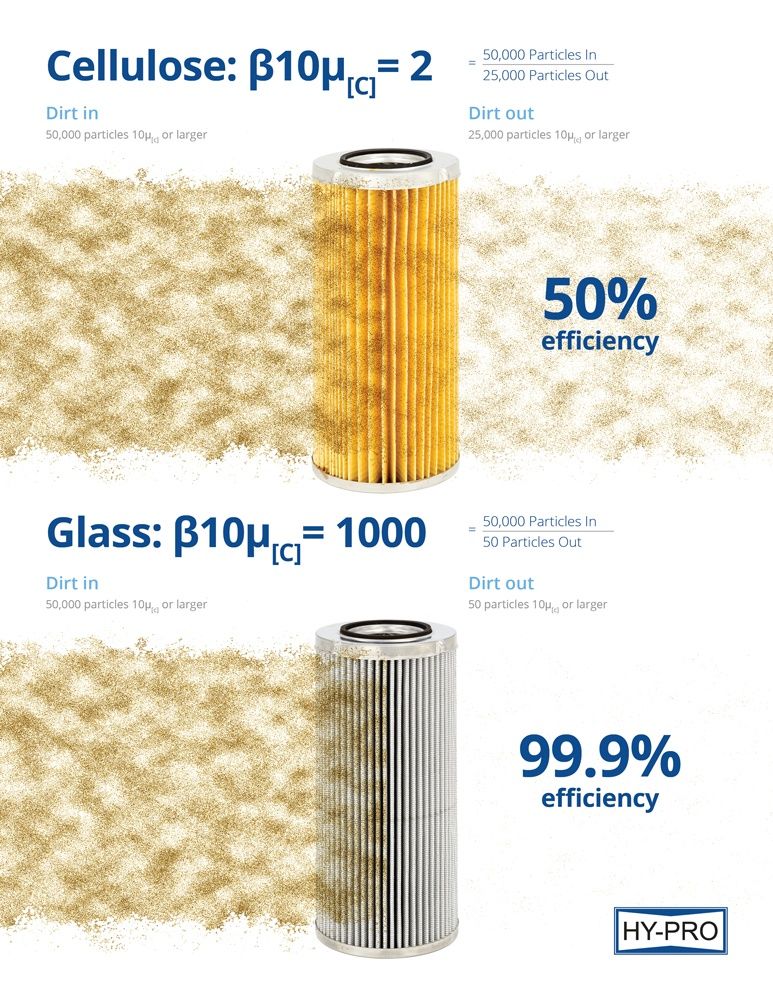
Normally, wire mesh and cellulose media elements are nominally rated, which means they might be only 50% efficient at the rated micron size. Most glass media elements are considered to be “absolute” rated which means that they are 99.5% efficient at the rated micron size. Check the Beta ratio before selecting the media as all “10 micron” filter elements do not filter with the same efficiency. Glass media has superior fluid compatibility versus cellulose with hydraulic fluids, synthetics, solvents and high water-based fluids. 

Elements of different media with the same “micron rating” can have substantially different filtration efficiency. The graphic below provides a visual representation of the difference between absolute and nominal filter efficiency.

cellulose filter media and glass filter media

The illustrated glass element would typically deliver an ISO Fluid Cleanliness Code of 18/15/8 to 15/13/9 or better depending upon the system conditions and ingression rate. The cellulose element would typically achieve a code no better than 22/20/17.

Cellulose vs. Glass: Fibers and Cleaning 

Runaway contamination levels at 4μ[c] and 6μ[c] are very common when cellulose media is applied where a high population of fine particles exponentially generate more particles in a chain reaction of internally generated contaminate.

Inorganic glass fibers are much more uniform in diameter and are smaller than cellulose fibers. Organic cellulose fibers can be unpredictable in size and effective useful life. Smaller fiber size means more fibers and more void volume space to capture and retain contaminate. 

Topics: hydraulic fluid ISO 16889 cellulose media filter elements filter comparison glass media

Featured

Sign up for updates